The compliance question most childcare directors ask too late
Picture this: an assessor arrives for an NQF review and asks to see your cleaning records. Not a summary — the actual evidence. What was cleaned, when, by whom, and how. If your cleaner hands you a signed paper sheet once a month, that is the moment the gap becomes visible.
Cleaning compliance in childcare is not just about a tidy centre. It sits inside Quality Area 2 of the National Quality Framework — Children's Health and Safety — and the expectation is documented, consistent practice, not good intentions.
Here is what the standards actually require, and what that means for the business of choosing and managing a cleaner.
What the NQF actually says about cleaning
The National Quality Framework does not hand you a cleaning checklist. What it does is set an outcome: children must be protected from infection, and the service must have written policies and practices that demonstrate how that outcome is achieved.
In plain terms, your regulator wants to see:
A documented cleaning schedule covering all areas — bathrooms, nappy-change areas, food-preparation surfaces, play areas, and high-touch points like door handles and light switches.
Evidence that the schedule is followed, not just that it exists.
Products and methods that are appropriate for use around children — including safe handling of any chemicals used on-site.
Clear procedures for cross-contamination prevention, particularly between toileting areas and food or play surfaces.
The 2025–26 NQF update has sharpened the focus on hygiene infrastructure — equipment, not just effort. Centres that can show they use purpose-fit equipment (HEPA-filter vacuums, for instance) are in a stronger position than those that cannot say what vacuum their cleaner brings through the door.
The cross-contamination problem nobody talks about
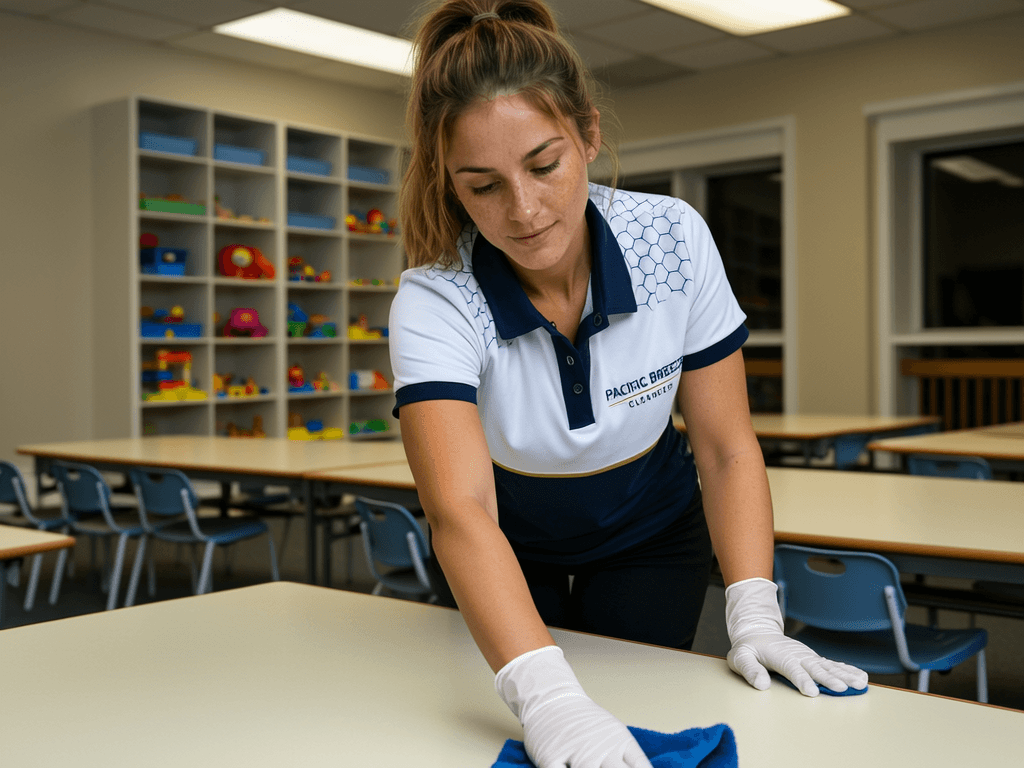
A lot of cleaning in childcare centres is done with cloths. The risk is obvious once you name it: a cloth that touches a toilet, a nappy-change surface, or a bin should never touch a kitchen bench or a tabletop where food is served. In practice, without a managed system, it happens.
A colour-coded cloth system — where each colour is assigned to a specific zone and never crosses into another — is one of the most practical answers to this problem. It only works if every cleaner on the site understands and follows it consistently, not just in theory but at 8 pm when they are tired and working alone.
The same logic applies to toilets specifically. Cloths that touch a toilet bowl or seat should be single-use for that task — finished, bagged, and done. No rag should travel from a toilet to anywhere else in the building.
When you are evaluating a cleaning service, this is a concrete question worth asking: how do you prevent cross-contamination between toileting areas and food surfaces? A company with a real system will give you a specific answer. A company without one will give you a general one.
Disinfection: what "clean" and "disinfected" actually mean
These two words are often used interchangeably. They should not be. Cleaning removes visible dirt and some microorganisms. Disinfection reduces the number of pathogens to a level that is unlikely to cause harm.
In a childcare setting — where children crawl on floors, put things in their mouths, and share surfaces constantly — disinfection of high-touch points is not optional. Nightly disinfection of door handles, light switches, taps, food surfaces, nappy-change areas, and bathroom fixtures should be a standard part of every clean, not something that happens when illness is going around.
Hypochlorous acid (HOCl) has become the disinfectant of choice in high-hygiene environments including hospitals, dental clinics, and — increasingly — childcare centres. It is effective against a broad range of pathogens, and it is safe around children and food surfaces when used correctly. If your cleaner is using it nightly, that is worth knowing. If they are not, it is worth asking what they use instead and why.
Documentation: what "evidence" looks like in practice
An assessor is not going to take your word for it that the bathroom was disinfected every night last quarter. They want a record.
What useful documentation looks like:
A task-by-task record for each visit — not a single sign-off, but confirmation that each area was addressed.
Records accessible to the service director without having to chase the cleaning company.
A clear way to raise issues and track that they were resolved — not just reported, but fixed and confirmed.
A cleaner who leaves a paper sign-off sheet is giving you evidence of presence, not evidence of cleaning. The distinction matters when an assessor is in the room.
The best cleaning services now provide a report after every visit — every task recorded, accessible to the client, and available whenever it is needed. If a task was missed and the client reported it, there should be a record of that too, along with confirmation it was corrected. That is the kind of documentation trail that supports your Quality Area 2 evidence folder.
Practical checklist: what to ask your cleaner
Whether you are reviewing your current arrangement or looking for a new provider, these questions cut through the generalities:
Do you use a colour-coded cloth system, and can you explain which colours go where?
What is your cross-contamination protocol for toileting areas?
What disinfectant do you use on food and nappy-change surfaces, and is it safe around children?
What equipment do you use for vacuuming — does it have HEPA filtration?
How do you document each clean, and how do I access those records?
If I report a missed task, how is that handled and recorded?
A cleaner who cannot answer these questions specifically is not set up for a regulated childcare environment — regardless of how long they have been in business.
The floor question
Floors in childcare centres are a particular hygiene challenge. Children play on them. They accumulate more than dirt — odours from urine and spills build up in ways that standard mopping does not address. A cleaner who treats childcare floors the same way they treat an office floor is not accounting for that.
We use a more hygienic floor process than traditional cleaning businesses, with a floor product chosen for hygiene that also removes the odours floors accumulate in childcare settings. That is as far as we will go in describing the method — it is something we take seriously enough not to shortcut.
If you run a childcare centre in Coffs Harbour and want to know how our cleaning approach supports your NQF compliance, see what we offer or get in touch — quotes come back within 48 hours.
Related
Where this fits in what we do, and what to read next.