The question most directors ask eventually
It usually comes up after a blitz clean — the centre looks great, everyone relaxes, and then six weeks later someone's wiping down a nappy-change bench that hasn't had a proper clean since. The real question isn't how good the last clean was. It's how often the clean needs to happen to keep the space genuinely hygienic, and what the National Quality Framework actually expects.
Here's a practical guide, written for directors and approved providers in the Coffs Harbour area.
What the NQF says (and what it doesn't)
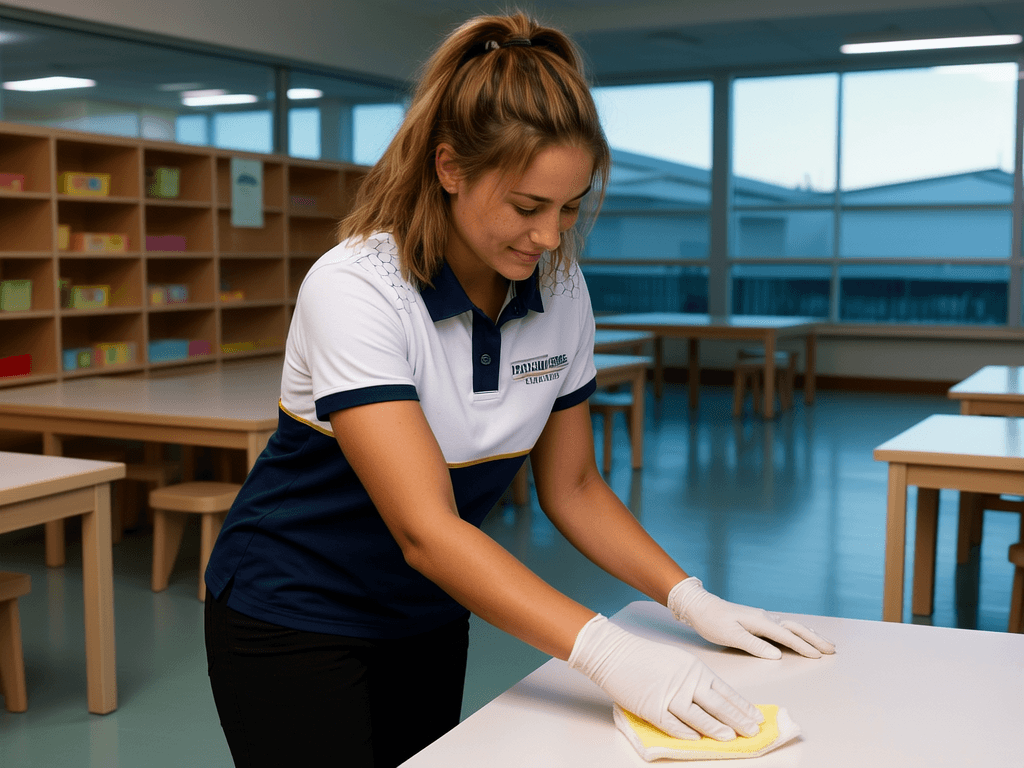
The National Quality Framework — specifically Quality Area 2, covering children's health and safety — requires centres to maintain a clean and hygienic environment. It does not prescribe a fixed number of cleans per week in black-and-white terms. What it does require is that cleaning and hygiene practices are documented, consistent, and demonstrably effective.
In practice, that means:
High-touch and high-risk surfaces (nappy-change areas, food preparation surfaces, bathrooms) need attention every single day.
Documented evidence of cleaning — not just verbal assurance — is what assessors look for.
The cleaning method matters, not just the frequency. Cross-contamination between a bathroom cloth and a food surface is a compliance failure even if cleaning happened daily.
The NQF has been reinforced by the 2025–26 cycle with sharper focus on hygiene documentation. Centres that can produce a cleaning record for every visit — not just a signature on a wall chart — are in a much stronger position during assessment.
Daily cleaning: what it covers and why it's the baseline
For most licensed childcare centres, a five-day-per-week professional clean is the practical minimum for maintaining compliance. Not because of a single rule that says so, but because of what accumulates daily: food residue, body fluids, hand contact on every door handle and light switch, floor contamination from crawling and play.
A proper nightly clean at a childcare centre should include, at a minimum:
Disinfection of all high-touch surfaces — door handles, light switches, taps, tables, chairs.
Full cleaning and disinfection of bathroom areas and all nappy-change surfaces.
Kitchen and food prep surface disinfection.
Floor cleaning with a hygiene-grade product (not just a mop and water).
Bin management and general tidying so staff arrive to a reset space.
At Pacific Breeze, every nightly clean at a childcare centre includes disinfection of high-touch surfaces, food surfaces, bathrooms and nappy-change areas using hypochlorous acid (HOCl) — a hospital-grade disinfectant made from salt, water and electricity. It's the same category of disinfectant used in hospitals, dental clinics and medical rooms, and it's safe to use around children and on food-contact surfaces. Centres on a daily clean with us also receive 15 litres of hypochlorous free every month — dropped into a container at the centre and renewed monthly — so your own staff have hospital-grade disinfectant on hand between cleans, at no cost. We also use a more hygienic floor process than traditional cleaning businesses, and a full colour-coded cloth system with a strict cross-contamination program — cloths that touch a toilet never go anywhere near a kitchen surface.
What about weekly or fortnightly cleans?
A fortnightly professional clean can work as a supplement to thorough daily staff cleaning routines — but it is rarely sufficient on its own for a licensed centre. The risk is straightforward: between visits, contamination builds on surfaces that staff don't always have time (or the right products) to address properly.
Weekly cleaning sits in a similar position. It reduces the gap, but for busy centres with high child-to-space ratios, seven days is a long time between professional disinfection of bathrooms and nappy areas.
Where weekly or fortnightly professional cleans can genuinely work:
Very small family day care settings with robust daily staff hygiene protocols.
As a supplemental deep-clean layer added on top of daily professional cleaning (e.g. a fortnightly deep clean of high-reach areas, behind furniture, under mats).
Documentation is half the answer
Frequency alone doesn't satisfy an NQF assessment. A centre that is cleaned daily but has no records is in a weaker position than one that can produce a line-by-line task record for every visit. When an assessor walks in, or when a parent asks a hard question, the answer is the paper trail.
That's one of the reasons we provide a report after every clean — not just when something goes wrong. Every task checked, every visit recorded, available to the centre director without having to chase anyone. If something gets missed and the director flags it, that task goes straight onto the site checklist so it cannot be missed again. A complaint becomes a permanent fix.
We also upgraded our equipment specifically to support NQF 2025–26 compliance — including Nilfisk GD5 HEPA-filter vacuums, which matter for air quality in spaces where children spend time on the floor.
The honest summary
For a licensed childcare centre in NSW:
Daily (five nights per week) professional cleaning is the practical standard for most centres, and the only frequency that keeps high-risk surfaces genuinely under control.
Weekly or fortnightly can work in limited circumstances, usually in combination with strong daily staff protocols — and it still needs documentation.
Frequency without documentation is a compliance gap, regardless of how good the cleaning is.
Method matters as much as frequency. A daily clean with poor cross-contamination practices can still fail a hygiene standard.
If you're reviewing your current arrangement — or setting up cleaning for the first time — the childcare centre cleaning page covers how we approach this in detail. For commercial cleaning across other site types in the Coffs Harbour area, the commercial cleaning page is a good starting point.
If you'd like a quote specific to your centre, get in touch — quotes come back within 48 hours, often the same day.
Related
Where this fits in what we do, and what to read next.